Medically Reviewed by Dr. Bryant Birch, DDS on October 17, 2026
 If you have been diagnosed with obstructive sleep apnea and the CPAP machine on your nightstand is not working for you, you have real options. CPAP is still the most studied treatment, but the leading sleep medicine guideline also recognizes custom oral appliances made by a dentist as a recommended alternative for adults who cannot tolerate CPAP or would prefer a different approach. Weight management, positional therapy, a newer prescription medication, and implanted nerve stimulation round out the list, and the right choice depends on how severe your sleep apnea is and what you can comfortably use every night.
At Birch Family Dental, our team helps patients in Green River, Wyoming, who are looking for alternatives to CPAP therapy, offering custom oral appliances designed for comfort and ease of use. We work alongside your physician or sleep specialist, so your appliance fits into a complete treatment plan rather than replacing medical care. You can see how the process works on our sleep apnea treatment page, and our focus on patient care and the latest technology helps us build an appliance that fits your mouth precisely.
The Role of Dentists in Treating Sleep Apnea
Sleep apnea is far more common than most people realize. In 2014, the American Academy of Sleep Medicine estimated that at least 25 million U.S. adults had obstructive sleep apnea. A more recent analysis published in Respiratory Medicine in 2025 puts the figure much higher, estimating that about 83.7 million U.S. adults, or roughly 32% of adults age 20 and older, were living with the condition in 2024, and that most cases remain undiagnosed.
Diagnosis belongs to a physician, usually through a home sleep test or an overnight study. Dentists often spot the first warning signs, such as worn teeth from grinding, a scalloped tongue, or dry mouth, which is why we explain how dentists help identify sleep apnea in a separate article. Once a diagnosis is in place, a dentist with training in oral appliance therapy can design, fit, and adjust the device your physician prescribes.
Why CPAP Does Not Work for Everyone
CPAP delivers a steady stream of air through a mask to keep your airway open, and it is very effective when it is used every night. The challenge is consistency. Many people find the mask uncomfortable, struggle with dry nose or mouth, feel claustrophobic, or dislike the noise and the hose. Others travel often or have trouble sleeping with equipment strapped to their face. A treatment that sits unused in a drawer does not protect your health, so finding something you can wear consistently matters as much as the device itself.
Untreated obstructive sleep apnea has been linked to high blood pressure, heart disease, type 2 diabetes, stroke, and depression. That is why it is worth talking with your physician and dentist about an alternative rather than simply stopping treatment if CPAP is not working for you.
What the Sleep Medicine Guideline Says About Oral Appliances
In 2015, the American Academy of Sleep Medicine and the American Academy of Dental Sleep Medicine published a joint clinical practice guideline on oral appliance therapy. It recommends that sleep physicians consider prescribing an oral appliance for adults with obstructive sleep apnea who are intolerant of CPAP or prefer an alternate therapy. It also suggests the appliance be custom made and adjustable, provided by a qualified dentist rather than purchased over the counter.
The guideline is candid about tradeoffs. CPAP generally does a better job of lowering the number of breathing interruptions per hour and improving oxygen levels, so it remains the first-line option for many patients, especially those with severe sleep apnea. Oral appliances are a recognized alternative, and the guideline suggests follow-up sleep testing to confirm the appliance is working, plus periodic visits with both your dentist and your sleep physician.
How Oral Appliances Keep Your Airway Open
During sleep, the muscles in your throat relax. In people with obstructive sleep apnea, the tongue and soft tissues fall back and narrow or block the airway, and your body briefly wakes to restart breathing. This can happen dozens of times an hour without you remembering it. Oral appliances work by holding your jaw or tongue in a position that keeps the airway open so that cycle is interrupted less often. There are two main types of oral appliances used to treat sleep apnea: mandibular advancement devices (MADs) and tongue-stabilizing devices (TSDs).
Mandibular Advancement Devices (MADs)
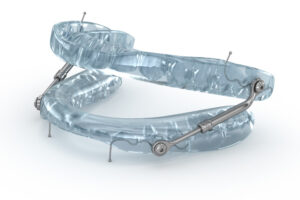
This is the most common oral appliance used to treat sleep apnea. It works by moving your lower jaw and tongue slightly forward to maintain an open airway. MADs come in two parts: one fits over your top teeth and the other fits over your bottom teeth. The two parts are connected with hinges, screws, or bands that hold your lower jaw forward and allow the position to be adjusted over time. Your MAD can be customized based on:
- Size
- Material (firm or soft)
- The method used to connect the top and bottom devices
- The extent to which your teeth touch when you close your mouth
- How far forward the device moves your jaw
That last adjustment is what the guideline means by a titratable appliance. We start at a comfortable position and advance it gradually until your symptoms and follow-up testing show improvement.
Tongue-Stabilizing Devices (TSDs)
Tongue-stabilizing devices, also known as tongue-retaining devices, use gentle suction to hold the tongue forward so it cannot fall back and block your airway. A small bulb sits just outside the lips while your tongue rests inside it. This type of device is used less often than mandibular advancement devices, but it can help people who cannot wear a MAD, such as those with few remaining teeth to anchor an appliance.
Other Alternatives to CPAP Your Physician May Discuss
Oral appliances are one piece of a wider picture. Your physician may recommend one of these approaches alone or alongside an appliance, depending on your diagnosis.
Weight Management and Medication
Extra weight around the neck and upper airway can make obstructive sleep apnea worse, and losing weight may reduce its severity for some people. In December 2024, the FDA approved tirzepatide (Zepbound) as the first prescription medication for moderate to severe obstructive sleep apnea in adults with obesity, used together with diet and exercise. This is a medical decision made with your physician.
Positional Therapy and Sleep Habits
Some people have breathing interruptions mainly when they sleep on their backs. Sleeping on your side, avoiding alcohol and sedatives close to bedtime, and keeping a consistent sleep schedule can help, especially in milder cases.
Nerve Stimulation and Surgery
For certain adults with moderate to severe sleep apnea who cannot use CPAP, physicians may consider an implanted hypoglossal nerve stimulator, which moves the tongue forward during sleep. Surgical options that address the nose, throat, or jaw are also available for selected patients. These treatments are handled by medical specialists, and we are happy to coordinate with them.
What to Expect When You Get an Oral Appliance
The process starts with a diagnosis and a prescription from your physician. At your consultation, we review your sleep study, examine your teeth, gums, and jaw joints, and confirm you have healthy enough teeth to support an appliance. We then take precise impressions or digital scans of your teeth and bite so your device can be fabricated to fit closely.
At your fitting appointment, we check comfort and placement and show you how to wear and clean the appliance. Over the next several weeks, we adjust the jaw position in small steps. Your physician may order a follow-up sleep test to confirm the appliance is reducing your breathing interruptions. After that, regular checkups help us watch for side effects such as jaw soreness, tooth tenderness, excess saliva, or gradual changes in your bite, which are known effects of long-term wear and can usually be managed. Because sleep apnea and oral health are closely linked, we also keep an eye on the connection between sleep apnea and oral health at every visit.
If you are looking for alternative solutions to treat your sleep apnea, talk with your dentist and physician about your options and get started on improving your sleep and getting back to enjoying life.
Frequently Asked Questions About Sleep Apnea Treatment
What are the main types of oral appliances for sleep apnea?
The two main types are mandibular advancement devices (MADs), which hold the lower jaw and tongue slightly forward, and tongue-stabilizing devices (TSDs), which use gentle suction to keep the tongue from falling back and blocking the airway. MADs are used far more often.
Are oral appliances as effective as a CPAP machine?
CPAP generally reduces breathing interruptions more than an oral appliance does, which is why it is still the first-line treatment for many people. The 2015 AASM and AADSM guideline recommends a custom, adjustable oral appliance for adults who cannot tolerate CPAP or prefer an alternative, and follow-up testing helps confirm it is working for you.
Do I need a sleep study before getting an oral appliance?
Yes. Sleep apnea is diagnosed by a physician, usually through a home sleep test or an overnight study. Snoring alone does not tell you whether you have sleep apnea or how severe it is, so a diagnosis and prescription come first, and then your dentist can design and fit the appliance.
Why not use an over-the-counter snoring mouthpiece?
Store-bought mouthpieces are not custom fitted and usually cannot be adjusted in small steps. The sleep medicine guideline suggests a custom, titratable appliance from a qualified dentist, which can be fine-tuned for your airway and checked over time for effects on your teeth and jaw.
How common is sleep apnea?
Sleep apnea is far more common than once believed. The American Academy of Sleep Medicine estimated at least 25 million affected U.S. adults in 2014, and a 2025 analysis in Respiratory Medicine estimated about 83.7 million U.S. adults, or roughly 32% of adults age 20 and older, had obstructive sleep apnea in 2024.
How do I know if an oral appliance is right for me?
Start by talking with your physician about your sleep study results and with your dentist about the health of your teeth and jaw. Together they can help determine whether an oral appliance, CPAP, or another approach is the right fit for your situation.
Birch Family Dental: Your Partner in Sleep Apnea Treatment
At Birch Family Dental, we offer patient-focused solutions for sleep apnea, including custom oral appliances that give many patients a comfortable alternative to CPAP machines. Dr. Bryant Birch and Dr. Tate Anderson coordinate with your physician or sleep specialist, adjust your appliance over time, and monitor your teeth and jaw at every checkup so your treatment stays comfortable and effective.
If you are ready to explore alternatives for managing sleep apnea and improving your quality of life, we would be glad to talk through your options. Reach out through our contact form to schedule a consultation.
ABOUT THE AUTHOR
Practice Owner
Dr. Bryant Birch earned his dental doctorate from Creighton University in 2006 and has owned Birch Family Dental in Green River, Wyoming, since 2011, where he and Dr. Tate Anderson provide custom oral appliances for patients with sleep apnea.