 The dental chair looks the same as it did decades ago, but what happens before, during, and after your appointment has been fundamentally transformed. Most patients in Green River remember the old process well: biting down into a tray of stiff impression material, holding perfectly still, and then waiting one to three weeks to return and pick up whatever the lab had returned.
At Birch Family Dental in Green River, Wyoming, this shift has been central to how Dr. Bryant Birch and Dr. Anderson serve patients across the region. Dr. Birch added CEREC technology to the practice in 2013, and the office now runs multiple intraoral scanning units and SprintRay 3D printing alongside in-house milling machines. Our dental technology workflow is built to handle most fabrication without sending anything to an outside lab.
From Impression Tray to Digital Scan
Getting a crown used to be a two-appointment process. At the first visit, you bit into a tray of impression material that had to harden completely while you held still. That physical mold was then sent to a dental lab, and patients waited before returning to receive the finished restoration.
What the Scanner Actually Does
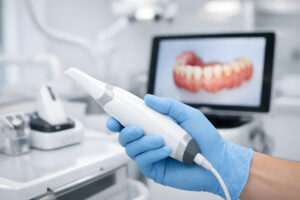
A digital intraoral scanner reads the contours of your teeth and surrounding tissue using a handheld wand. Each pass records thousands of data points, and the system assembles them into a three-dimensional model visible on the monitor in real time. CAD/CAM systems built on this kind of data address three distinct problems dentists have always faced: making sure restorations are strong enough for daily use, achieving a natural appearance, and making the fabrication process faster and more reliable.
Dr. Birch added CEREC same-day crowns to the practice in 2013, which made it possible to design and mill a restoration in a single appointment without relying on an outside lab. With two providers on staff and multiple scanning stations available, we can block out longer appointments so patients dealing with significant treatment can get more done in fewer visits.
How the 3D Printer Fits In
The SprintRay 3D printer on-site serves a different purpose than the milling machine. Rather than carving from a solid block, it uses resin and scan data to build appliances layer by layer. Custom night guards come out shaped around that specific patient’s bite geometry, not averaged from a generic sizing chart.
This matters for patients who clench or grind their teeth and need a guard that actually stays in place. Beyond night guards, our printer handles surgical guides for implant placement, diagnostic models used for treatment planning, and trial smile appliances that let patients see what a proposed cosmetic change would look like before agreeing to proceed. That last application has made a real difference in how our patients engage with proposed treatment: being able to visualize the outcome makes the decision feel far less abstract.
What Patients Notice When They Come In
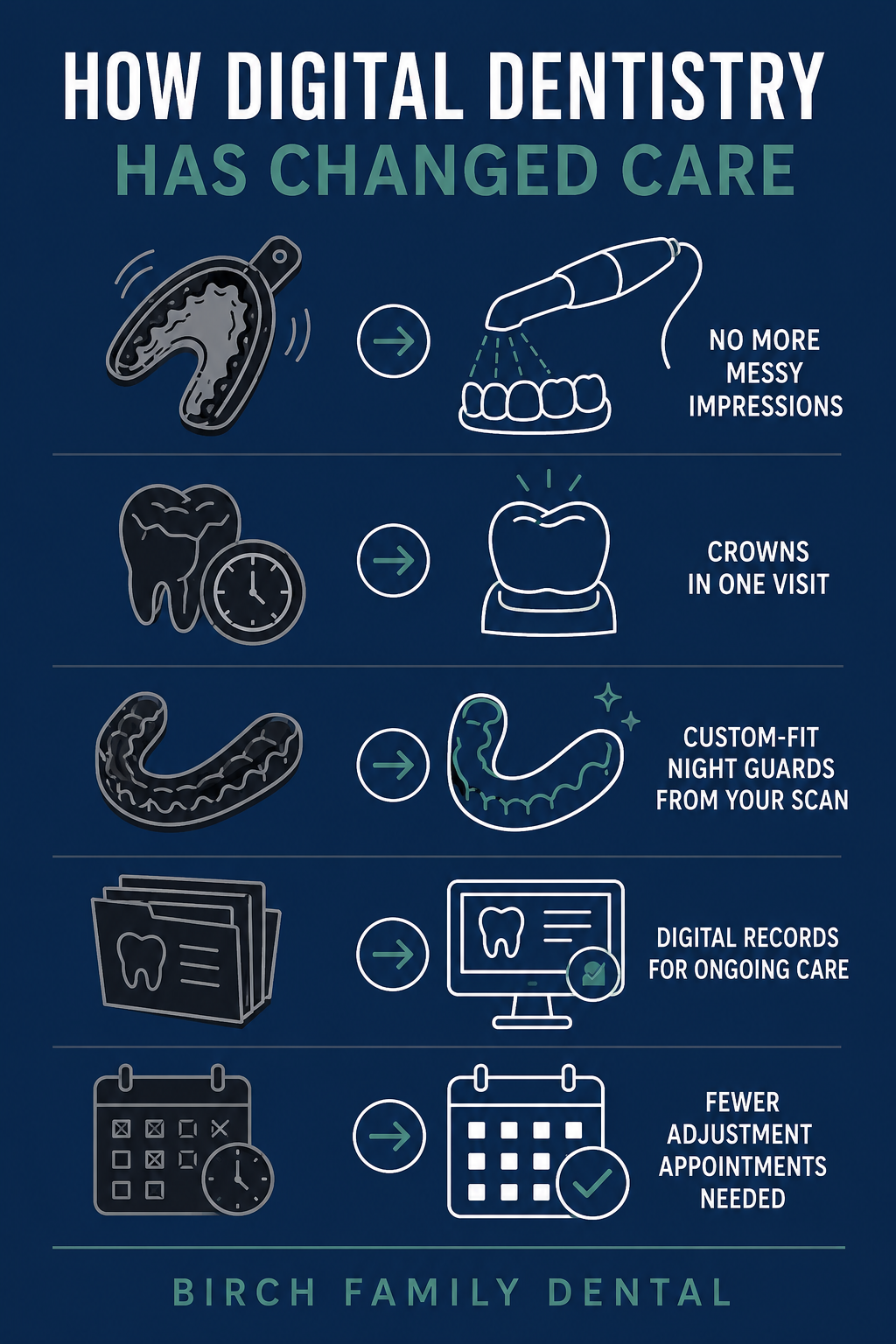
For patients who remember dental visits from ten or fifteen years ago, the shift in process is hard to miss. Some of the differences that come up most often include:
- No impression trays or the discomfort that comes with them
- Same-day crowns and restorations completed without a return visit
- Night guards and other appliances built from individual scan data rather than general sizing
- Digital records on file and accessible for future treatment comparisons
- Fewer adjustment appointments because the fit is based on precise measurements
A 2023 survey published in the Journal of the American Dental Association found that among dental offices using 3D printing, 68% reported improved efficiency as a key advantage, and nearly half reported using the technology for splints, occlusal devices, and diagnostic models. For our patients, that efficiency translates into fewer appointments and less time away from work or family.
Seeing the Whole Picture in Real Time
One reason Dr. Birch invested in this technology is that it changes the conversation in the room. When the digital scan is visible on the monitor, patients can see what is going on with their own teeth rather than trying to interpret an X-ray or take a provider’s word for it. That visibility is a core part of how we approach patient education, and it tends to make treatment feel less like something being done to a patient and more like a decision they are part of making.
For patients who need more complex care, the office-based anesthesia sedation options we offer make it possible to complete more in a single extended appointment. We are also one of the only dental practices in the region with a nurse anesthetist on staff, which gives patients who need sedation for longer or more involved procedures a level of support that most offices simply cannot provide.
Choose Birch Family Dental in Green River, Wyoming
Birch Family Dental has been serving the Green River community since 1974, when Dr. D. Wayne Birch opened the practice. Dr. Bryant Birch took over in 2011 and has continued adding technology and restorative dentistry capabilities in the years since, from CEREC milling in 2013 to SprintRay printing and multiple scanning units that now support a full in-house fabrication workflow. Dr. Anderson’s arrival added clinical depth, expanding what we can handle in general, cosmetic, and surgical cases without referring patients elsewhere.
If you are curious about what a digital appointment looks like, or if a crown, night guard, or other restoration has been on your to-do list, contact our office to schedule a visit and find out what same-day and in-house options may work for you.